
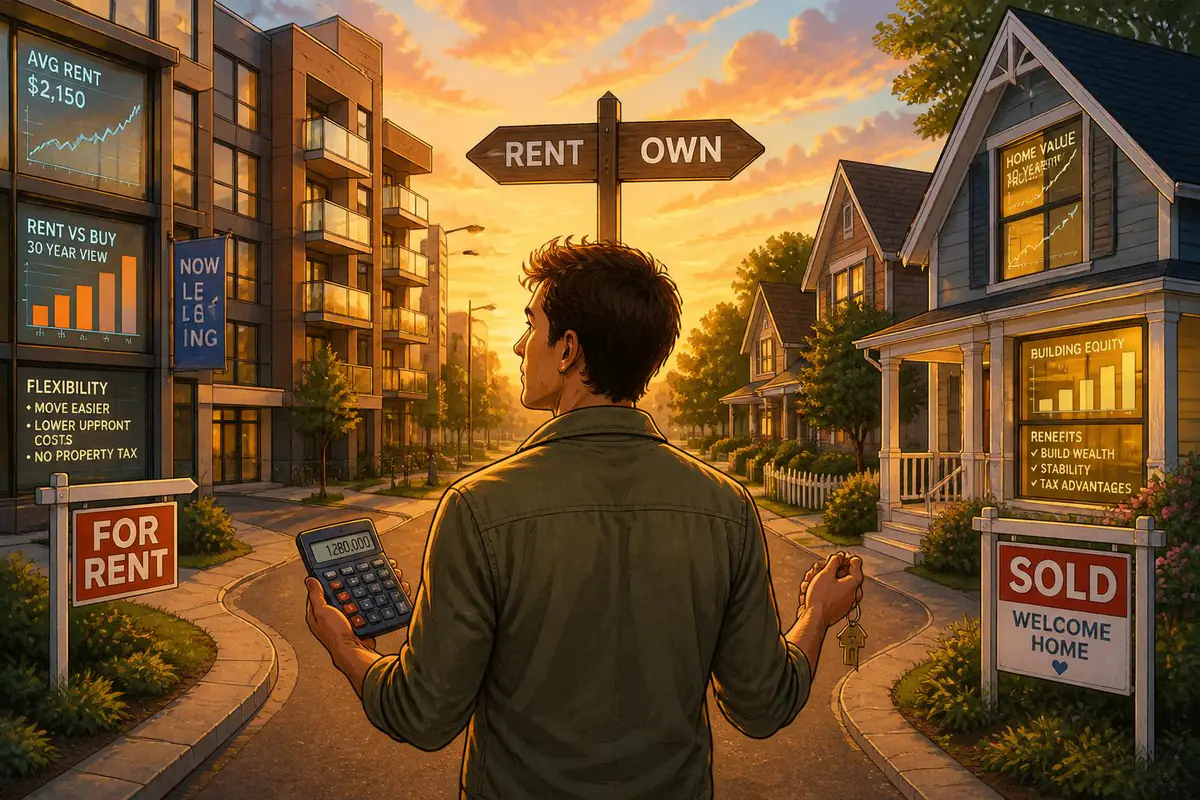
Renting vs. Buying a Home: The New Math You Need to Run
For decades, people have repeated the same advice: buying a home is always better than renting. But today, with changing interest rates, soaring prices, and shifting lifestyles, that old rule no longer works. You now need a new and more realistic math to decide whether renting or buying is right for you.
This decision is not just financial. It affects your freedom, stress levels, career choices, and even your relationships. The good news is that you can make a confident choice when you break the problem into clear, simple steps.
The True Cost of Owning vs. Renting
When most people compare renting and buying, they only look at monthly rent versus monthly mortgage. That is a huge and costly mistake. The true cost of owning includes many hidden items renters often forget.
To compare fairly, create two columns: one for owning, one for renting. Then list every cost you can think of, not just the obvious ones. Consider this breakdown as a starting point:
- Owning costs: mortgage payment, property taxes, homeowner’s insurance, private mortgage insurance (if applicable), HOA fees, maintenance and repairs, larger utility bills, closing costs, moving costs, renovation or furniture upgrades.
- Renting costs: monthly rent, renter’s insurance, possible parking or pet fees, annual rent increases, moving costs when leases end.
Once you write these out, you start to see that the monthly mortgage number alone is only one piece of a much bigger puzzle. A mortgage that looks “cheaper than rent” can easily become more expensive when you add everything else.
The New Math: Compare Total Monthly Impact
The new way to compare renting vs. buying is to calculate your total monthly financial impact for each option. That means not just what leaves your bank account, but also what you keep or build.
You can think of your situation like this simple framework:
| Factor | Renting | Buying |
|---|---|---|
| Cash Out | Rent + fees | Mortgage + taxes + insurance + maintenance |
| Cash Back or Savings | Money saved because of lower upfront costs | Principal portion of mortgage (equity) |
| Flexibility Value | Easy to move for opportunities | Harder and more expensive to move |
| Risk | Rent increases, eviction risk | Price declines, costly repairs, job loss impact |
To run the numbers, start with three questions:
- How much money leaves my pocket each month in each scenario?
- How much of that money builds long‑term financial value for me?
- How much flexibility or risk comes with each path?
This shifts the conversation from “Is buying always better?” to “Which combination of cost, wealth building, and flexibility serves me best now?”
Time Horizon: How Long Will You Stay?
One of the most powerful variables is how long you plan to stay in the home. The shorter your time horizon, the more likely renting makes sense. The longer you stay, the more buying can pay off, if the other numbers also work.
Why? Because buying has huge upfront transaction costs: closing costs when you buy and agent fees and other expenses when you sell. These costs are spread over however many years you live there. If you move again in two or three years, those costs per year are very high. If you stay ten or more years, the annual cost is much lower.
A practical rule of thumb: if you’re unsure you can stay for at least five to seven years, renting often gives you better flexibility and lower risk. If you are confident you will stay longer, buying deserves a much closer look.
Interest Rates, Prices, and the Market You Live In
Another reason the old advice no longer works is that markets have changed dramatically. In some cities, home prices have outrun incomes by a wide margin. In others, rents have climbed faster than ownership costs. You cannot rely on national averages; you must look at your own area.
Key local factors to research include:
- Average rent for the type of home you want now and in the near future.
- Typical purchase price for similar properties in your target neighborhoods.
- Current mortgage interest rates and how they affect your monthly payment.
- Property tax levels and any recent or upcoming changes.
Run a quick experiment: find one or two real homes you could rent and one or two you could realistically buy. Use those actual numbers instead of hypothetical averages. That alone makes your decision far more grounded and personal.
Down Payment, Savings, and Emergency Cushion
Buying often requires a large down payment, plus closing costs, moving expenses, and initial repairs or furnishings. If making that purchase drains your savings completely, you may be buying too soon.
A safer approach is to make sure you still have an emergency cash cushion after you buy. Many advisors suggest three to six months of living expenses, but if your income is variable or your job is unstable, aiming higher may be wise.
Renting, by contrast, usually requires less upfront cash: a security deposit, first month’s rent, maybe some fees. The difference between what you would have spent buying and what you spend renting can be invested or saved. Over time, those investments may grow in a way that partially or fully offsets not owning a home.
Lifestyle, Flexibility, and Stress
Numbers matter, but you are not a calculator. Your life stage, career plans, and personality are just as important as spreadsheets. Owning a home can provide a deep sense of stability, pride, and control. You can paint the walls, plant a garden, and shape your space freely.
On the other hand, homeownership brings responsibilities: repairs, maintenance, unexpected breakdowns, and the mental load of managing a major asset. If you are building a career that may require relocation, or if you simply value maximum flexibility and freedom, renting can be a better match.
A helpful exercise is to write down your top three lifestyle priorities for the next five years. Examples might be:
“Grow my career quickly, even if it means moving.”
“Start a family and create stability for kids.”
“Travel often and keep my fixed costs low.”
Then ask honestly: does renting or buying support those priorities better right now?
Practical Step‑by‑Step Decision Checklist
To apply this new math to your own life, follow this simple checklist:
- Clarify your time horizon: minimum and likely years in the same area.
- Write down all ownership and renting costs for realistic properties.
- Calculate your total monthly out‑of‑pocket in each scenario.
- Estimate how much of that becomes equity or invested savings.
- Check your emergency fund after a potential purchase.
- Rate your need for flexibility versus stability on a 1–10 scale.
- Review how each choice aligns with the next five years of your life plan.
When you complete these steps, the answer often becomes clearer than you expected. The goal is not to find a perfect solution, but to make a calm, informed, confident decision that fits your real life, not outdated rules.
Whether you end up renting or buying, remember: your home is both a financial decision and a personal one. Use the new math, honor your priorities, and choose the path that gives you both financial resilience and a life you are excited to live inside those walls.